
Touchless Faucet Buying Guide for Homes, Hotels, Offices, Schools, and Healthcare Facilities
The best touchless faucet is not a single product or universal specification. It is the faucet whose sensing method, flow rate, power supply, outlet pattern, temperature control, accessibility, maintainability, and certification profile match the building in which it will operate.
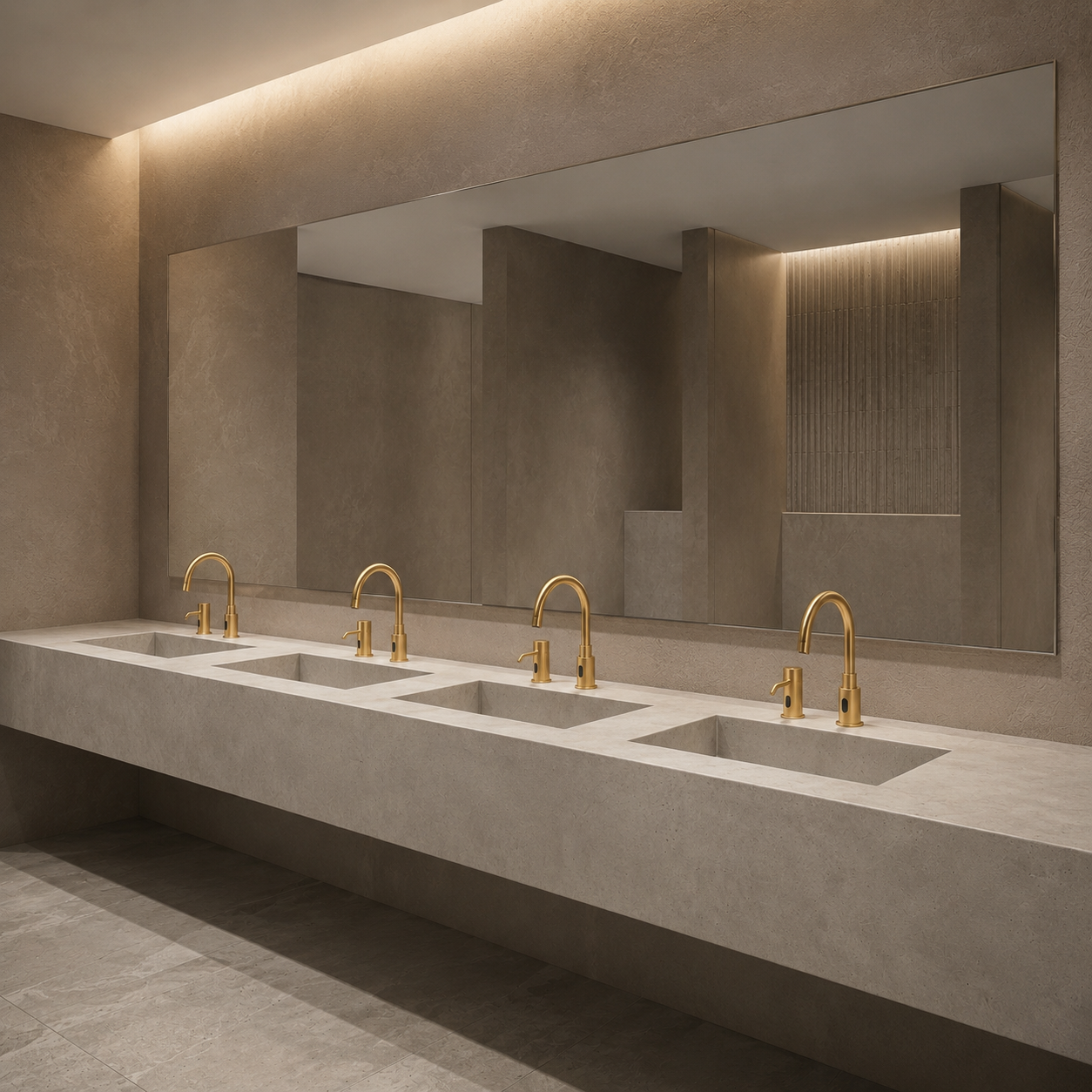
How this guide defines the best touchless faucet
Product reviews often reduce selection to sensor speed, finish, price, or star ratings. AEC teams need a broader method. This guide evaluates touchless faucets as plumbing fittings connected to building water, electrical, accessibility, maintenance, and operational systems.
Regulatory fit
The first test is whether the faucet, outlet, installation, and complete lavatory arrangement satisfy the adopted plumbing, accessibility, electrical, energy, water-efficiency, and health requirements for the project location.
Functional fit
The faucet must activate predictably, keep water within the basin, provide an appropriate handwashing stream, deliver safe temperatures, and remain usable by the intended population.
Operational fit
Facility teams need realistic access to filters, batteries, power supplies, solenoids, mixing controls, outlets, isolation valves, diagnostics, parts, and technical documentation.
Determine whether the faucet is for private or public use
A common specification error is applying one faucet schedule to every lavatory in a mixed-use project. Homes and restricted guest bathrooms are generally private-use applications. Office restrooms, school restrooms, hotel lobbies, event spaces, and other facilities exposed to walk-in traffic are public-use applications.
Private-use bathroom faucets may be evaluated under the EPA WaterSense lavatory-faucet program. Public-use lavatory faucets are addressed separately through plumbing codes and standards. Federal purchasing guidance identifies a maximum flow rate of 0.5 gallons per minute for public lavatory faucets and 0.25 gallons per cycle for metered faucets.
Always confirm the adopted code, local amendments, project type, authority having jurisdiction, and whether the room is restricted or open to public traffic.
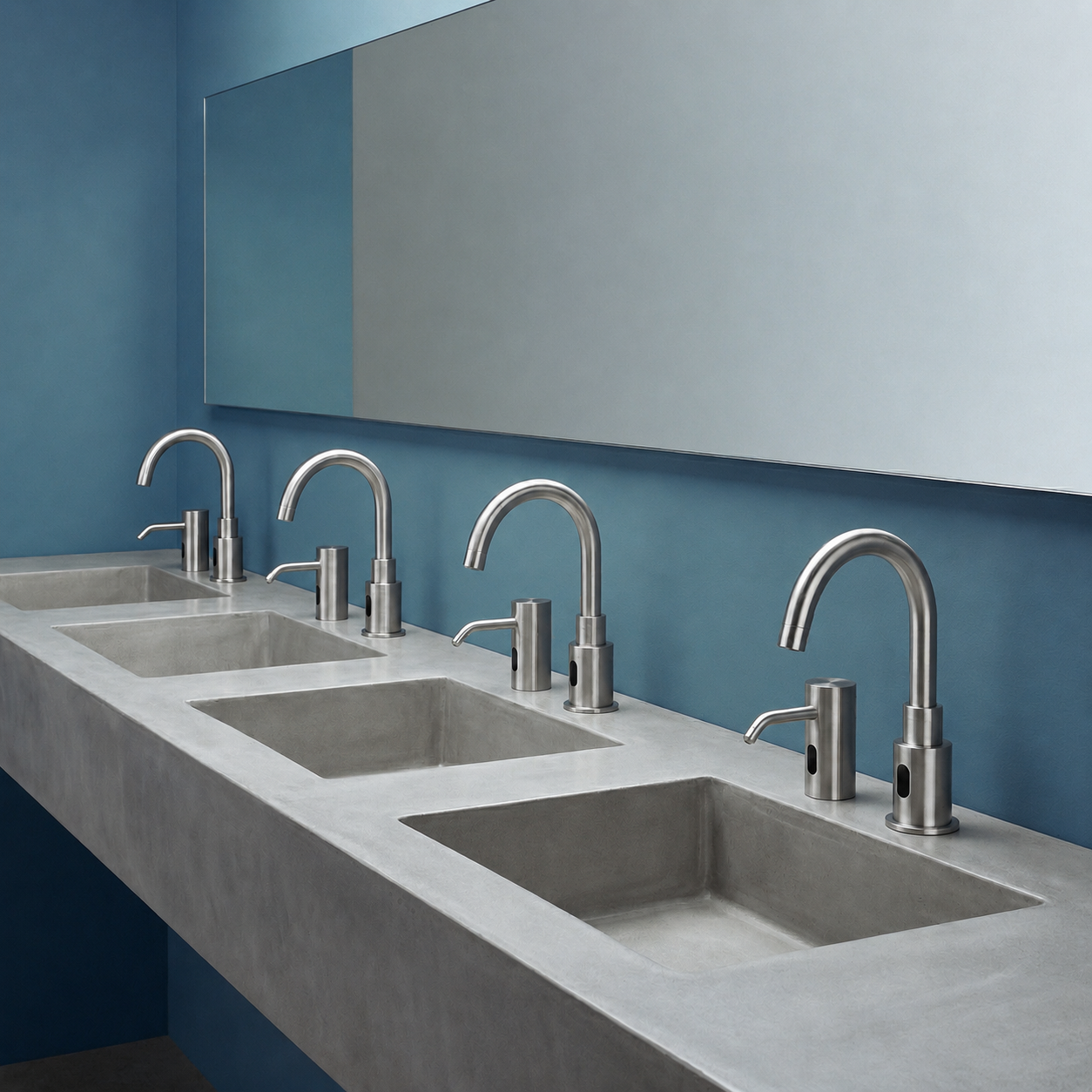
What to evaluate before selecting a touchless faucet
A product should not be approved from a photograph or abbreviated sales description. Require a complete technical submittal and evaluate the following criteria against the project basis of design.
Sensor performance
Review the detection technology, adjustable range, activation zone, response behavior, shutoff delay, maximum run time, false-trigger resistance, and performance with the selected sink and surrounding finishes.
Reflective basins, shallow sinks, dark surfaces, mirrors, soap dispensers, lighting, and adjacent faucets can affect sensing. Mock-up testing is more reliable than evaluating the spout alone.
Flow rate and stream quality
Verify the rated flow at the specified pressure and confirm whether the outlet is aerated, spray-forming, or laminar. The lowest numerical flow is not automatically the best choice if it produces poor rinsing, excessive splash, or longer activation times.
Test the complete faucet-and-basin combination under anticipated pressure conditions.
Power architecture
Battery power simplifies retrofit work. AC power reduces routine battery replacement but requires coordinated electrical work. Hybrid systems may use hardwired power with battery backup or another secondary source.
Compare power failure behavior, battery type, battery access, low-power indication, controller location, transformer requirements, and replacement procedure.
Temperature control
Determine whether the faucet supplies cold water, tempered water, or user-adjustable mixed water. Review the mixing valve location, adjustment security, scald-control strategy, thermal-disinfection compatibility, check valves, and local code requirements.
Do not assume a sensor faucet controls temperature merely because it controls flow.
Sink compatibility
Coordinate spout reach, discharge angle, mounting-hole size, deck thickness, vessel height, overflow location, drain position, backsplash, and sensor line of sight.
Water should land within the basin without striking a steep wall, drain component, or user’s hands in a way that creates splash outside the fixture.
Accessible operation
Automatic operation can remove the need to grasp, pinch, or twist a control, but it does not make the complete lavatory accessible by itself.
Confirm clear floor space, approach, reach, lavatory height, knee and toe clearance, protected piping, counter geometry, mirror location, and any manual temperature control.
Materials and certifications
Require documentation for the applicable plumbing-supply fitting standard and potable-water health requirements. Verify certification by exact model and configuration instead of relying on a general manufacturer statement.
Typical review items include ASME A112.18.1/CSA B125.1, NSF/ANSI/CAN 61, and NSF/ANSI/CAN 372 where applicable.
Service access
Check whether the strainer, outlet, solenoid, sensor cable, power supply, controller, batteries, mixing valve, and stops can be reached without removing the sink, cutting sealant, or opening finished walls.
Serviceability often has more effect on long-term value than decorative finish.
Diagnostics and commissioning
Useful diagnostics include low-battery indication, sensor-status feedback, fault codes, manual override, purge functions, configurable timeout, and accessible test procedures.
Ask what tools or applications are required and whether future access depends on a proprietary account or subscription.
Durability and abuse resistance
High-traffic and unsupervised environments may require concealed fixings, tamper-resistant outlets, protected cables, robust mounting hardware, vandal-resistant enclosures, and resistance to cleaning chemicals.
Confirm that the product’s duty classification matches expected use rather than relying on the word “commercial.”
Documentation and parts
Require installation instructions, wiring diagrams, exploded parts views, troubleshooting procedures, maintenance intervals, approved cleaning methods, model-specific certifications, and a replacement-parts list.
Establish expected parts availability and approved equivalents before a portfolio-wide rollout.
Lifecycle cost
Compare purchase price together with installation labor, transformers, batteries, replacement outlets, solenoids, service visits, downtime, water use, cleaning impact, stocking requirements, and eventual replacement.
A low-cost faucet can become expensive when repeated access or proprietary components are required.
Battery, hardwired, or hybrid power?
There is no universally superior power source. The appropriate choice depends on construction type, expected cycles, access, maintenance staffing, resilience goals, electrical coordination, and the consequences of a faucet being unavailable.
Often practical for retrofits
Battery operation can avoid branch-circuit and transformer work. It is often appropriate where access beneath the sink is straightforward and the facility has a reliable preventive-maintenance program.
Review carefully
- Expected cycles per battery set
- Replacement battery type and quantity
- Low-battery indication
- Tool-free or secured battery access
- Failure mode when voltage is low
Useful for planned construction
Hardwired power can reduce battery-management work in large facilities, but it requires electrical coordination, accessible transformers, compliant wiring, and a defined response to power outages.
Review carefully
- Individual or shared transformer design
- Access to power supplies and junctions
- Voltage-drop and cable-length limitations
- Emergency-power requirements
- Isolation for servicing one fixture
Potentially resilient, but more complex
Hybrid arrangements can combine primary and backup sources. They may suit high-use locations where continuity matters, provided the facility understands the added components and maintenance procedure.
Review carefully
- Which source is primary
- Automatic transfer behavior
- Battery replacement despite AC availability
- Diagnostics for each power source
- Availability of replacement controllers
How selection changes by building type
The same faucet may perform well in a private residence and poorly in an airport-style washroom—or work in an office but conflict with a healthcare water-management strategy. Begin with the operating context.
Homes and apartments
Residential buyers typically prioritize intuitive operation, appearance, quiet valve action, safe temperature adjustment, compatibility with existing cabinetry, and straightforward battery replacement.
Recommended priorities
- Predictable sensing for adults, children, and assisted users
- A manual or clearly documented power-loss strategy
- Private-use flow performance appropriate to local requirements
- Accessible temperature control where mixed water is provided
- Simple cleaning without damaging the sensor window or finish
- Readily available filters, outlets, batteries, and solenoids
Common mistake
Selecting a commercial-looking faucet without checking whether its under-deck control box, battery pack, hoses, and mixing components fit the vanity.
Hotels and resorts
Hotels often require two specifications: one for private guest bathrooms and another for public lobby, restaurant, conference, spa, and ballroom restrooms. These locations have different traffic, flow-rate, monitoring, and maintenance conditions.
Recommended priorities
- Separate guestroom and public-area faucet schedules
- Consistent guest operation without training or signage
- Finish resistance to housekeeping chemicals
- Fast room-level maintenance with minimal guest disruption
- Standardized hidden components across multiple finish options
- Spare-parts planning for long renovation cycles
Common mistake
Applying the same flow rate, power source, and service arrangement to a low-use suite and a heavily used convention-center restroom.
Offices and commercial buildings
Workplace restrooms need repeatable performance across many fixtures. Standardization, public-use flow limits, accessible operation, easy sensor adjustment, and efficient scheduled maintenance usually matter more than decorative variation.
Recommended priorities
- Public-use flow compliance and verified handwashing performance
- Sensor range suited to the selected sink and countertop
- Hardwired or centrally managed power where justified by scale
- Interchangeable service parts across floors or properties
- Clear low-power and fault indications
- Commissioning records for every bank of fixtures
Common mistake
Assuming automatic shutoff guarantees water savings without measuring actual flow, run time, false activation, and pressure.
Schools and universities
Educational buildings combine high traffic, varied user height, unsupervised use, scheduled closures, laboratories, food service, athletic areas, and service sinks. Not every sink should receive the same faucet type.
Recommended priorities
- Robust mounting and protected under-deck components
- Tamper-resistant outlets and secured power access
- Detection suitable for smaller hands where children are present
- Splash testing at the actual basin and operating pressure
- Shutdown and recommissioning procedures after long closures
- Separate specifications for restrooms, classrooms, laboratories, kitchens, and service areas
Common mistake
Using a public-restroom handwashing faucet at a classroom, laboratory, art-room, or service sink that has a different functional purpose.
Hospitals, clinics, senior care, and healthcare facilities
Healthcare selection requires the most project-specific review. A touchless faucet reduces the need to touch a handle, but it must not be treated as a stand-alone infection-prevention solution. The faucet, outlet, sink, drain, water temperature, supply piping, stagnation potential, cleaning procedure, flushing protocol, and patient population are part of the risk assessment.
Recommended priorities
- Review by the facility water-management and infection-prevention teams
- Location-specific assessment for patient rooms, public areas, staff areas, clinical handwashing, laboratories, and utility spaces
- Outlet selection coordinated with facility policy and local health requirements
- Compatibility with flushing, monitoring, sampling, remediation, and thermal-control procedures
- Minimal concealed water volume and accessible internal components
- Documented cleaning and disinfection compatibility
- Commissioning under actual hot- and cold-water operating conditions
Important limitation
Do not specify an aerator, laminar outlet, automatic purge function, mixing arrangement, or low-flow setting solely from a generic buying guide. The correct configuration depends on the facility’s water-management program, the clinical use of the sink, adopted regulations, and the risk profile of occupants.
Common mistake
Equating “hands-free” with “infection proof” while overlooking internal faucet complexity, water age, outlet maintenance, sink-drain interaction, temperature control, flushing, and corrective-action procedures.
Touchless faucet requirements by application
The following table is a design-screening tool. It does not replace the project specification, adopted codes, manufacturer submittals, infection-control review, or approval by the authority having jurisdiction.
| Application | Typical use classification | Power preference | Primary risks | High-priority features | Commissioning emphasis |
|---|---|---|---|---|---|
| Homes | Private use | Battery, AC, or hybrid depending on renovation scope | Cabinet fit, confusing controls, dead batteries, splash | Simple temperature control, power-loss strategy, accessible batteries | Child and adult sensing, basin landing point, mixed-water temperature |
| Hotel guestrooms | Private use | Battery or coordinated AC | Guest confusion, housekeeping chemicals, room downtime | Intuitive use, quiet operation, finish durability, rapid parts replacement | Room mock-up, housekeeping review, temperature consistency |
| Hotel public areas | Public use | AC or hybrid often worth evaluating | High event traffic, queues, false activation, service disruption | Public-use flow, robust mounting, diagnostics, standardized components | Multi-user testing, adjacent-sensor interference, peak-pressure operation |
| Offices | Public use | AC, hybrid, or maintainable battery fleet | Inconsistent floors, delayed maintenance, water waste | Standard parts, low-power alerts, adjustable range, service access | Flow verification, sensor timeout, representative sink-bank testing |
| Schools | Usually public use | Secured battery, AC, or hybrid | Tampering, smaller users, seasonal stagnation, varied sink functions | Protected components, tamper-resistant outlet, smaller-hand detection | User-height testing, splash testing, closure and reopening procedure |
| Healthcare | Private or public depending on location | Project-specific, with resilience and access review | Waterborne hazards, inappropriate outlet choice, inaccessible internals | Water-management compatibility, minimal complexity, documented maintenance | Clinical-area review, flushing verification, temperature and corrective-action testing |
A practical weighted scorecard
A scorecard helps prevent finish, initial price, or one impressive feature from dominating the decision. Adjust the weighting to the project, but require every proposed product to pass mandatory code and certification criteria before scoring.
Calculate total cost instead of purchase price
Total ownership cost should be evaluated over the project’s planning horizon. The calculation does not need to be complex, but it should include the costs that change between alternatives.
Suggested lifecycle-cost equation
Total installed and operating cost = faucet purchase + plumbing installation + electrical installation + commissioning + batteries and power supplies + preventive maintenance + corrective maintenance + replacement parts + water and water-heating cost + access and downtime cost − recoverable utility incentives.
Use actual facility labor rates, expected fixture quantity, operating days, anticipated activations, measured water pressure, utility rates, service-access conditions, and replacement-part pricing whenever possible.
Measure existing conditions
Record current flow, use duration, pressure, fixture count, service calls, leak history, battery work, and operating schedule before predicting savings.
Model realistic operation
Include false activations, sensor timeout, cleaning activity, user behavior, seasonal occupancy, and whether users reactivate low-flow faucets for longer periods.
Verify after installation
Compare actual flow, run time, complaints, maintenance calls, and water use with the design assumptions. Adjust sensors and maintenance procedures where necessary.
What a touchless faucet specification should require
The final specification should be coordinated with Division 22 plumbing requirements, Division 26 electrical work where applicable, architectural sink and counter details, accessibility requirements, controls, and facility closeout procedures.
Product and performance data
- Exact manufacturer, series, model, finish, outlet, power, and mixing configuration
- Rated flow in gallons per minute and liters per minute at stated pressure
- Metered volume per cycle where applicable
- Sensor type, adjustable range, shutoff delay, and maximum run time
- Static and dynamic pressure limitations
- Hot- and cold-water temperature limitations
- Spout reach, height, discharge angle, and mounting requirements
- Deck-thickness and mounting-hole requirements
- Controller, solenoid, filter, check-valve, and mixing-valve arrangement
Compliance and certification data
- Applicable plumbing-supply fitting certification by exact model
- Potable-water health-effects certification where required
- Lead-content certification where required
- Water-efficiency certification where applicable to the use classification
- Accessibility documentation for controls and installation conditions
- Electrical listing and power-supply information where applicable
- Local code and authority-having-jurisdiction requirements
- Environmental-product or material disclosures required by the project
Maintenance and closeout data
- Exploded parts diagram with replaceable component numbers
- Battery type, quantity, replacement process, and disposal requirements
- Approved cleaning chemicals and prohibited cleaners
- Filter, strainer, outlet, and sensor-cleaning procedures
- Troubleshooting and diagnostic instructions
- Special tools, keys, programming devices, or applications
- Warranty scope, exclusions, and service contacts
- Recommended spare-parts schedule for project quantity
Installation and testing requirements
- Coordination with sink, counter, drain, backsplash, mirror, and accessories
- Accessible stops, transformers, batteries, controllers, and mixing devices
- Flushing and debris removal before connection or startup
- Flow-rate verification at representative fixtures
- Sensor-range and timeout calibration
- Splash and hand-position testing
- Mixed-water temperature verification
- Power-loss and low-battery testing
- Training, commissioning records, and final settings log
Commission the faucet as an installed assembly
Factory settings cannot account for every sink, reflective surface, water pressure, mounting height, lighting condition, or adjacent fixture. Commissioning should verify the installed condition rather than confirming only that water appears.
- Inspect: confirm model, outlet, power source, mixing configuration, stops, strainers, cables, and service access.
- Flush: remove installation debris in accordance with project and manufacturer procedures.
- Activate: test representative adult and child hand positions where relevant.
- Calibrate: adjust sensor range, timeout, and shutoff behavior without creating unintended activation.
- Measure: verify flow and mixed-water temperature under operating pressure.
- Observe: inspect splash, drainage, basin containment, and interaction with soap dispensers and adjacent faucets.
- Challenge: test low power, power interruption, blocked sensor, long activation, and any manual override.
- Record: document final settings, test results, deficiencies, corrective actions, and responsible personnel.
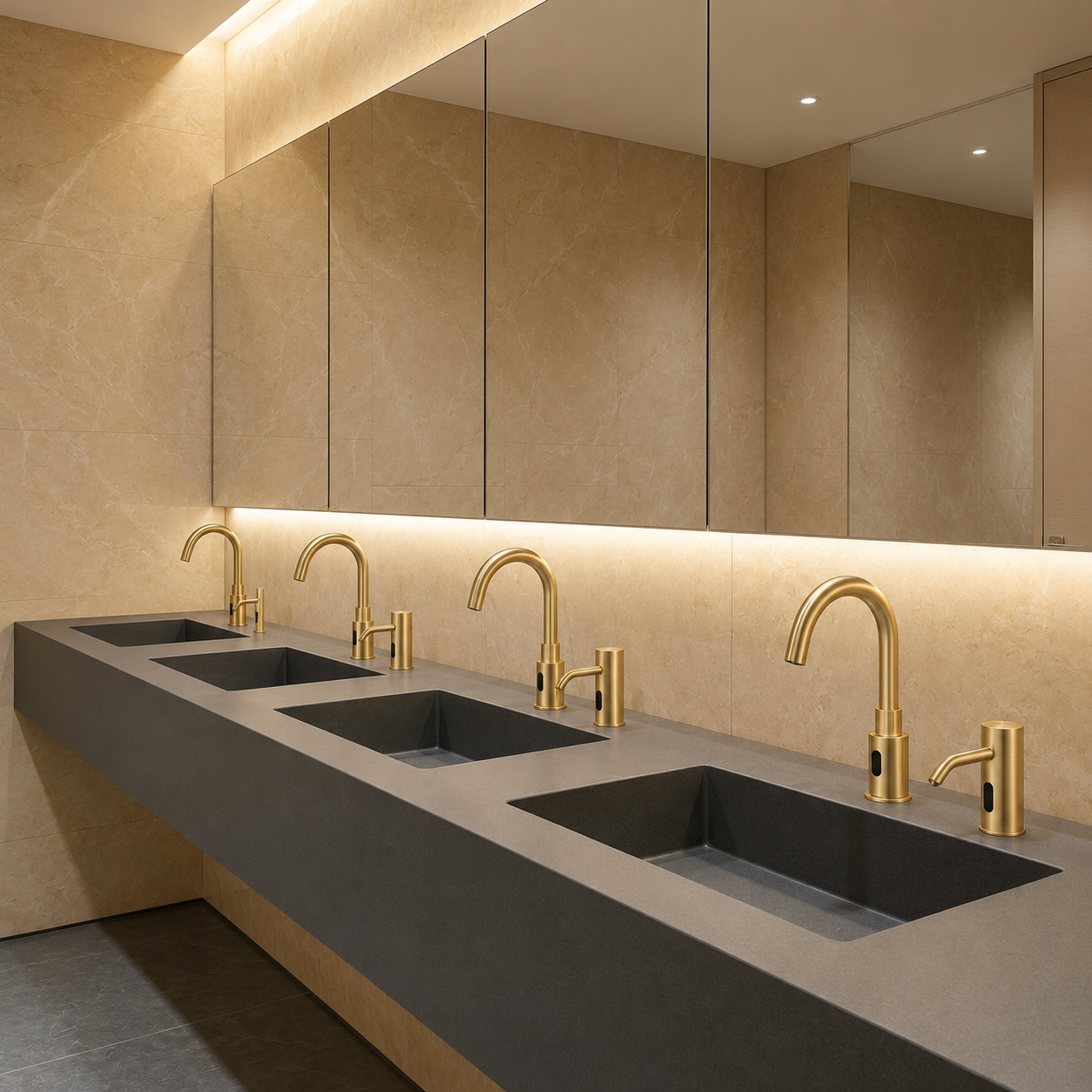
Plan maintenance before approving the faucet
Automatic faucets contain components that require inspection and occasional replacement. Maintenance access and staff training should be reviewed during design, not after a restroom is occupied.
Routine inspection
Check activation, shutoff, leaks, stream pattern, splash, outlet condition, sensor cleanliness, loose fittings, warning indicators, and evidence of tampering.
Water-side service
Inspect strainers, filters, outlets, check valves, solenoids, flexible supplies, mixing devices, and isolation valves according to facility and manufacturer procedures.
Power-side service
Track battery installation dates, transformer locations, cable condition, low-power reports, backup-source status, and correct disposal of depleted batteries.
Records and trends
Log repeat failures, response time, parts used, technician labor, water complaints, and affected locations. Repeated faults may indicate a design or commissioning issue rather than isolated product failure.
Common touchless faucet buying mistakes
Buying by finish first
Decorative coordination matters, but it should follow verification of sensing, flow, temperature, certification, sink fit, service access, and power requirements.
Using one schedule everywhere
Mixed-use projects frequently contain private, public, clinical, food-service, laboratory, classroom, and service sinks with different operating requirements.
Assuming lower flow is always better
Excessively low flow can reduce stream coverage, increase perceived waiting, cause repeated activation, or perform poorly at low pressure. Test the use case.
Ignoring the sink
A faucet cannot be evaluated independently from the basin. Spout reach, discharge angle, drain location, depth, slope, and reflective surfaces affect performance.
Hiding service components
A clean architectural elevation can create expensive maintenance when batteries, controllers, filters, solenoids, transformers, and valves are inaccessible.
Skipping field calibration
Factory defaults may cause missed activations, false starts, long run times, or interference. Final settings should be tested and recorded after installation.
Relying on generic certification claims
Certification can vary by model, outlet, flow rate, finish, power package, or mixing configuration. Verify the exact submitted assembly in the certifier’s listing.
Overstating hygiene claims
Touchless operation reduces contact with faucet handles. It does not eliminate the need for cleaning, handwashing technique, water management, outlet maintenance, and infection-prevention procedures.
Ignoring future parts
Before a large purchase, confirm the expected supply of solenoids, sensors, controllers, battery holders, transformers, outlets, seals, and model-specific service tools.
Touchless faucet buying questions
What is the best touchless faucet?
The best touchless faucet is the compliant model that activates reliably in the selected sink, provides the required flow and temperature, is accessible to intended users, can be serviced without destructive access, and has documented certifications and replacement parts. The answer changes by room and building type.
Do touchless faucets always save water?
No. Automatic shutoff can limit water left running between uses, but actual savings depend on flow rate, activation duration, sensor calibration, false triggering, water pressure, maintenance, and user behavior. Measure existing use and verify post-installation performance.
Are touchless faucets automatically ADA compliant?
No. Automatic activation can avoid gripping and twisting, but accessibility applies to the complete lavatory. Clear floor space, approach, reach, rim or counter height, knee and toe clearance, exposed piping, mirrors, and any manual controls must also be evaluated.
What flow rate should a touchless faucet have?
The required flow depends on private or public use, applicable codes, local regulations, outlet type, water pressure, and the sink’s function. DOE guidance identifies 0.5 gallons per minute for public lavatory faucets and 0.25 gallons per cycle for metered faucets. Private-use lavatory criteria should be checked against current EPA WaterSense and local requirements.
Is battery or hardwired power better?
Battery power is often easier for retrofits. Hardwired power may reduce routine battery work in large new projects. Hybrid systems can provide backup capability. Evaluate access, expected cycles, outage behavior, electrical coordination, diagnostics, and maintenance staffing.
Should every school sink use a touchless faucet?
Not necessarily. Public restroom handwashing sinks, classroom sinks, laboratory sinks, art-room sinks, kitchens, athletic facilities, and service sinks perform different tasks. The faucet and flow must match the sink’s actual function.
Are touchless faucets always preferable in healthcare facilities?
No universal rule applies to every healthcare sink. The facility’s water-management team, infection-prevention staff, engineers, and clinical representatives should assess the faucet, outlet, sink, water temperature, internal components, flushing needs, maintenance, and patient population.
What certifications should a buyer request?
Requirements vary by jurisdiction and application. Common review items include compliance with ASME A112.18.1/CSA B125.1 and certifications related to NSF/ANSI/CAN 61 and NSF/ANSI/CAN 372. WaterSense applies to eligible private-use lavatory faucets rather than every public-use faucet. Verify exact-model listings.
How can splash be prevented?
Coordinate spout reach, outlet height, discharge angle, stream pattern, flow rate, operating pressure, basin depth, basin slope, drain position, and hand placement. Build and test a representative mock-up when many identical fixtures are planned.
What spare parts should facilities keep?
The appropriate inventory depends on project scale, but frequently serviced items may include batteries, outlets, strainers, seals, solenoids, sensor modules, controllers, power supplies, mixing components, check valves, and model-specific tools.
Primary standards and research sources
These sources support further project-specific verification. Standards, codes, certification listings, and agency guidance can change; confirm the edition adopted for the project jurisdiction.
EPA WaterSense
Private-use lavatory-faucet efficiency, performance, product-search information, and commercial-facility water-management guidance.
DOE Federal Energy Management Program
Purchasing and best-management guidance for public-use lavatory faucets, metering faucets, and water-efficient fixtures.
U.S. Access Board
Technical guidance for accessible lavatories, sinks, faucets, operable parts, clearances, approaches, and protected piping.
ASME
Scope and requirements for plumbing supply fittings under ASME A112.18.1/CSA B125.1.
NSF/ANSI/CAN 61
Health-effects criteria and certification information for potable-water components, including endpoint plumbing devices such as faucets.
NSF/ANSI/CAN 372
Technical requirements and verification information related to lead content in drinking-water system components.
CDC Healthcare Water Management
Guidance for comprehensive healthcare water-management programs and control of waterborne hazards.
CDC Water Management Toolkit
Building-owner and facility guidance for developing, monitoring, and maintaining water-management programs.
WELL Building Standard
Performance-oriented building-health framework addressing water quality, monitoring, management, and occupant well-being.
