
Best Touchless Faucets for Healthcare Facilities: Hygiene, Auto-Purge, Sensor Reliability & Serviceability
Touch-free faucets can remove one frequently handled surface from the handwashing sequence, but healthcare fixture selection requires a broader view. Water stagnation, filtration, temperature management, sensor reliability, cleaning access, serviceability and the facility’s water-management program all matter. We compare five commercial touchless platforms through that healthcare engineering lens.
What We Look for in Clinical & Healthcare Restrooms
Consistent automatic activation without requiring contact with faucet handles.
Line-purge or scheduled-flush functions where appropriate to the facility water plan.
Accessible filters, valves, electronics and isolation for rapid maintenance.
Stable detection that minimizes missed activation and unnecessary water cycling.
Predictable shutoff, flow options and compatibility with temperature-control strategy.
Installation, maintenance, parts and commissioning information for facility teams.
Five Healthcare Touchless Faucet Selections
| Product | Best Healthcare Strength | Key Engineering Feature |
|---|---|---|
| Fontana Hospital Style Adjustable Commercial Faucet | Clinical restroom integration | Adaptive sensing + AC/DC + solid brass |
| BathSelect Hospital Style Adjustable Faucet | Healthcare hygiene stations | Infrared AI + adjustable shutoff + touchless soap pairing |
| Sloan BASYS EFX-600 | Stagnation management | Line Purge mode + above-deck diagnostics |
| American Standard NextGen Selectronic | Auto-purge & easy service | Periodic purge + all service parts above deck |
| Zurn Serio ZG6950 | Scheduled line flushing | Gear-driven valve + programmable line flush |
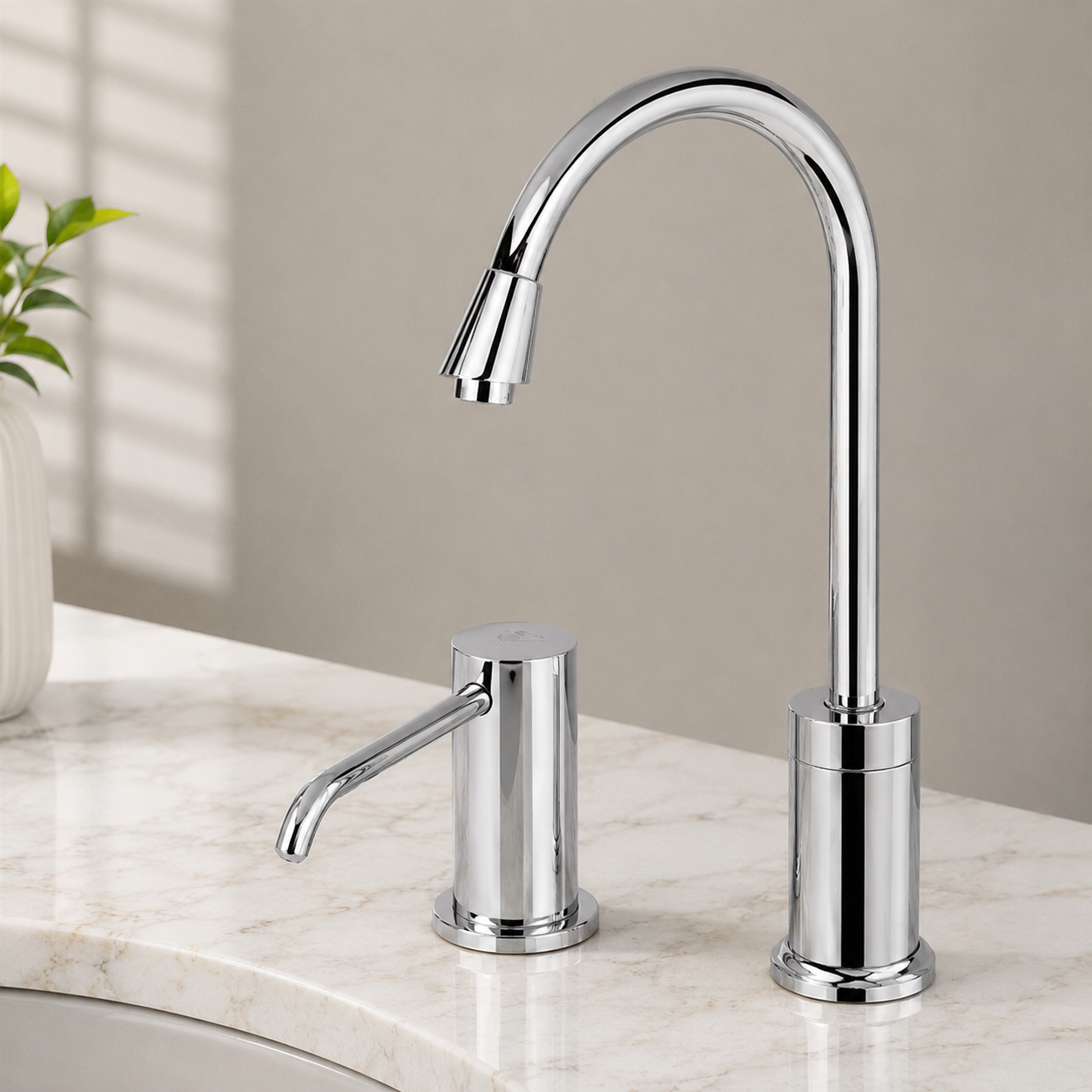
Fontana Hospital Style Adjustable Commercial Automatic Touchless Sensor Faucet
The Fontana Hospital Style Adjustable Commercial Automatic Touchless Sensor Faucet is specifically positioned for hospital and high-traffic commercial environments.
Its microprocessor self-adjusts the detection zone according to lavatory conditions, while the platform supports AC or DC power, a water-resistant solenoid enclosure, adjustable 30-second automatic shutoff and ADA-compliant touch-free operation.
Healthcare-focused commercial positioning with adaptive sensing and flexible power.
Coordinate flow, temperature and flushing strategy with the facility water-management plan.
BathSelect Hospital Style Adjustable Commercial Automatic Touchless Sensor Faucet
BathSelect’s hospital-style platform combines automatic water activation with an available matching touchless soap dispenser, reducing the number of manually operated components in the handwashing sequence.
The faucet uses an infrared AI smart-chip, solid-brass construction, AC/DC power and adjustable automatic shutoff. It is specifically identified for hospitals and public facilities.
Supports coordinated touchless water and soap delivery within one healthcare vanity concept.
Soap selection, replenishment procedures and faucet water-management requirements remain separate facility decisions.
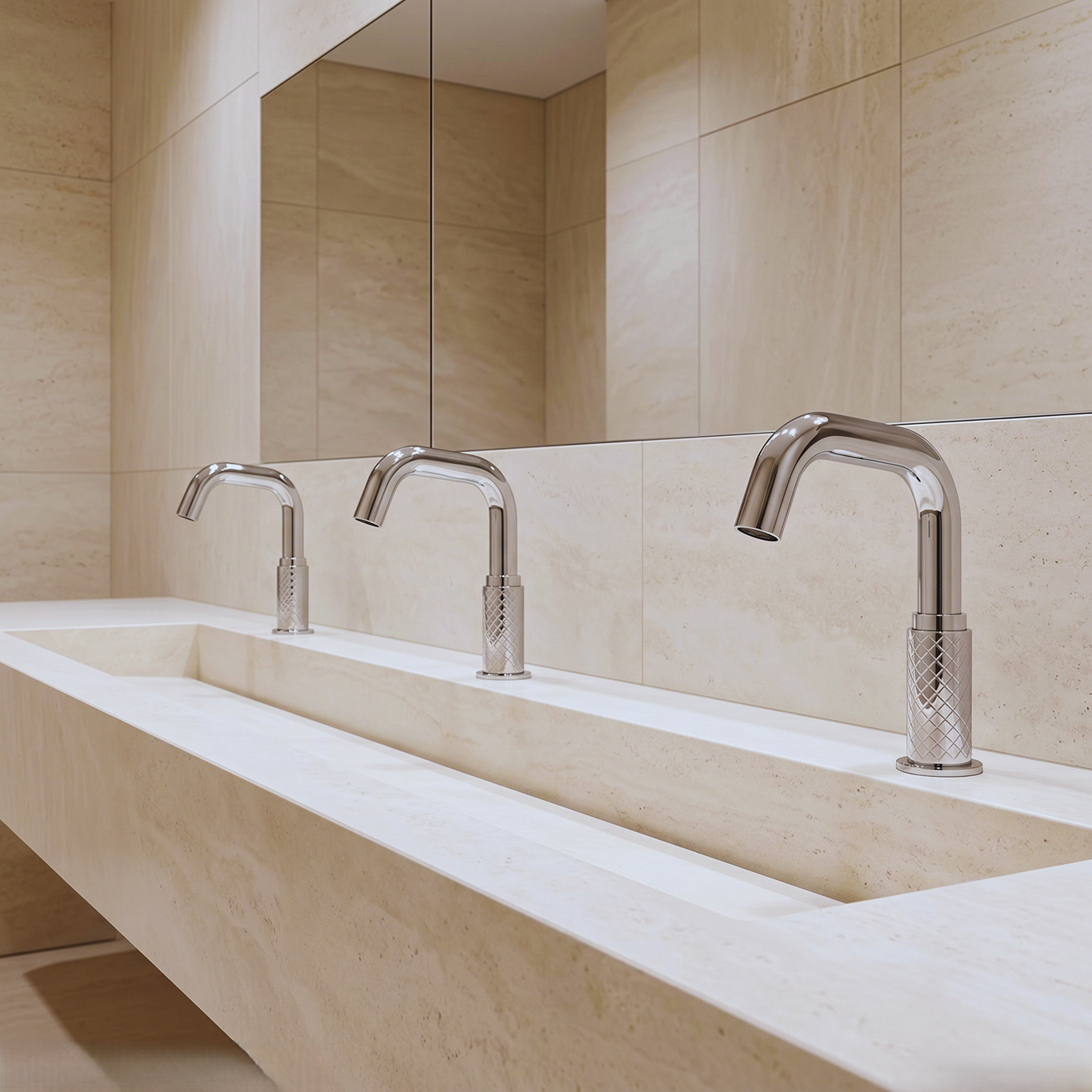
Sloan BASYS® EFX-600 Commercial Sensor Faucet
The BASYS platform stands out for healthcare because Sloan explicitly provides a Line Purge mode intended to eliminate stagnant water.
It also combines automatic-setting dual infrared sensors, sealed IP67 electronics, diagnostic indicators, a removable solenoid carrier, integral shutoff and an above-deck serviceable supply strainer.
Line-purge functionality is paired with unusually strong maintenance access.
Purge settings should be coordinated with the building’s formal water-management program rather than enabled arbitrarily.
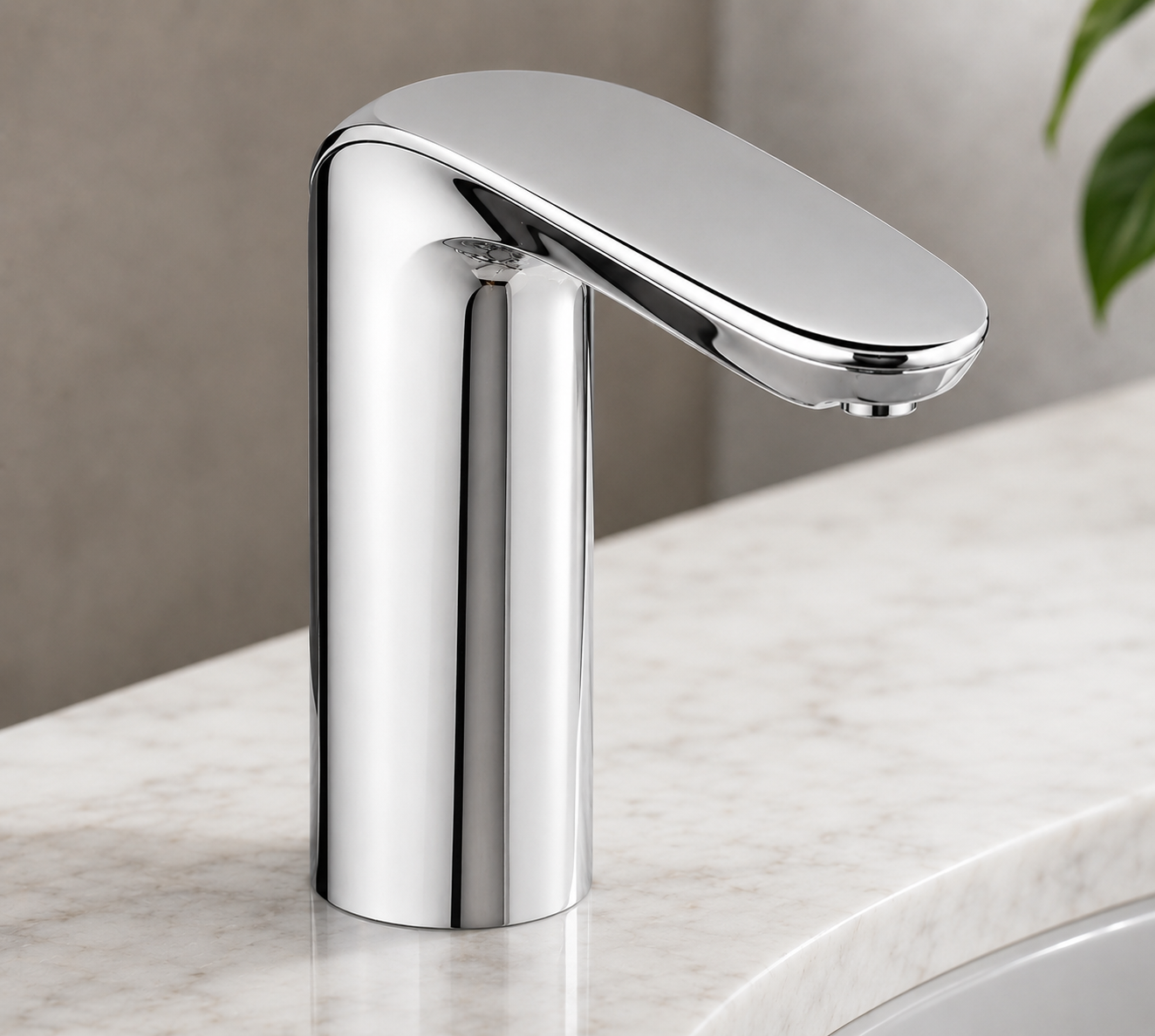
American Standard NextGen® Selectronic® 0.35 GPM Touchless Faucet
NextGen Selectronic combines two healthcare-relevant features: periodic Auto Purge for stagnant-water management and a fully integrated electronics package that places serviceable components in the faucet instead of a separate under-counter control box.
The current 0.35 GPM version also uses a vandal-resistant pressure-compensating multi-laminar spray and a 55-second safety shutoff.
Auto-purge functionality plus straightforward top-side maintenance.
Ultra-low flow and purge frequency should be assessed with the exact basin and facility water plan.
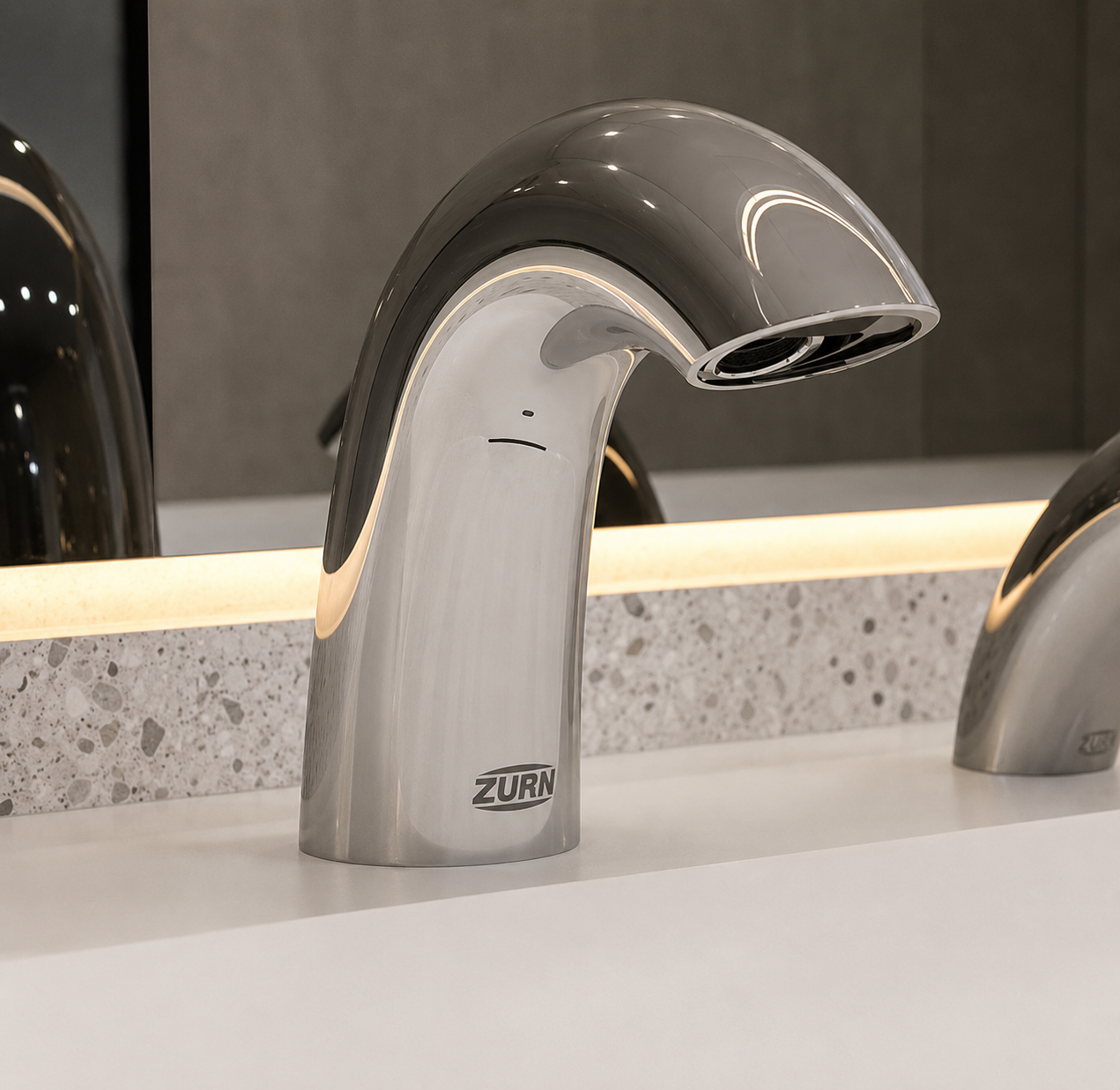
Zurn Serio Series® ZG6950 Gear-Driven Sensor Faucet
The current Serio platform allows programmed metering and automatic line flushing through its connected control architecture.
Zurn’s EZ Gear system also replaces the conventional solenoid with a motor-driven ceramic cartridge designed for improved debris tolerance—an important consideration where facilities want fewer traditional solenoid service points.
Programmable flushing and alternative valve architecture provide a different healthcare-maintenance strategy.
Scheduled flushing should be documented, monitored and tied to the facility’s broader water-management objectives.
Image standard: each featured product uses exact model or verified manufacturer product imagery displayed uncropped at 500+ px on desktop, and every image links directly to its corresponding product page.
Auto-Purge Is Useful—but It Is Not a Complete Water-Safety Program
Scheduled faucet operation can help address local stagnation, particularly at outlets that may sit unused for extended periods. However, flushing frequency should not be selected in isolation.
Healthcare water management also considers building distribution temperatures, disinfectant residuals, occupancy, dead legs, fixture use patterns and local risk conditions.
Touchless Does Not Mean “Sterile”
Touch-free activation removes the need to operate a faucet handle during routine use. That can reduce one contact point, but healthcare hand hygiene still depends on appropriate washing technique, soap availability, environmental cleaning, facility workflows and water-system management.
WHO’s WASH FIT framework specifically treats hand hygiene together with water, sanitation, environmental cleaning, waste management and broader facility management.
What Engineers Should Ask Before Procurement
| Purge / flush capability | Can it be scheduled, adjusted and documented? |
| Sensor | Is detection self-adjusting or field programmable? |
| Filtration | Can strainers be cleaned without major disassembly? |
| Power | Battery, AC, hybrid or renewable—and what happens during failure? |
| Temperature | How is tempered water or point-of-use thermostatic protection handled? |
| Service access | Can the valve, sensor and power components be replaced rapidly? |
Healthcare Touchless Faucet Brands to Know
Healthcare Touchless Faucet FAQ
Do touchless faucets prevent healthcare-associated infections?
No faucet should be presented as a stand-alone infection-prevention solution. Touchless activation can remove a contact point, but IPC depends on broader hand-hygiene, cleaning and water-management practices.
What is auto-purge?
Auto-purge periodically activates the faucet after a defined period or schedule to move water through the local fixture and supply path.
Is automatic flushing always better?
No. Frequency and duration should be selected within the facility water-management program because unnecessary flushing can waste water without addressing broader system risks.
Why are strainers important in healthcare faucets?
They help protect small valve passages from supply debris and can make maintenance more predictable.
Should healthcare faucets be hardwired?
Hardwired or hybrid power can reduce battery-service events, but the best architecture depends on facility infrastructure and continuity planning.
What flow rate should healthcare public lavatories use?
Public restroom applications often evaluate 0.35–0.5 GPM configurations where appropriate, subject to local code, clinical use and handwashing performance requirements.
What should be tested during commissioning?
Sensor response, shutoff, flow, temperature, purge programming, filtration access, power-failure behavior and maintenance access should all be documented.
Professional Sources
World Health Organization — WASH FIT, Second Edition
Risk-based healthcare-facility guidance covering water, sanitation, hand hygiene, environmental cleaning and facility management.
WHO — WASH in Health Care Facilities
Healthcare water, sanitation, hygiene and environmental-cleaning framework.
WHO Guidelines on Hand Hygiene in Health Care
Evidence-based hand-hygiene guidance for healthcare workers and facilities.
American Society of Plumbing Engineers
Commercial plumbing engineering and healthcare fixture design resources.
NSF/ANSI/CAN 61
Health-effects requirements for materials and components contacting drinking water.
The Best Healthcare Faucet Must Work With the Water-Management Program
Fontana and BathSelect provide strong healthcare-oriented touchless platforms with adaptable sensor control; Sloan BASYS stands out for line-purge functionality and service access; American Standard integrates auto-purge with highly accessible electronics; and Zurn offers programmable flushing through a newer gear-driven valve architecture. The strongest choice is the faucet that facilities, infection-prevention teams and plumbing engineers can manage together throughout the building lifecycle.
Review Fontana Hospital Style Touchless Faucet →Independent editorial disclosure: BestTouchlessFaucets.com provides independent engineering-oriented product analysis. Touchless fixtures do not by themselves prevent infection or control building waterborne pathogens. Healthcare specifications should follow the facility’s infection-prevention program, water-management program, applicable codes and current manufacturer documentation.